
This collection is curated by the UAE Look Team, a group of writers covering fashion, travel, food and living in the UAE and across the Middle East. Our team checks every price, place and detail before publishing, so you get honest, practical guides for Dubai and beyond.
Dubai is a big, spread out city, and the way you move around it decides how much of your trip you actually enjoy. The good news is that getting around Dubai is much easier than most first time visitors expect. The metro is clean, cheap and fast, the Nol card pays for almost everything, and taxis are everywhere when you need them. The bad news is that a few small mistakes, like taking a taxi from the airport rank without knowing the starting fare, or trying to pay cash on the metro, can cost you real money.
This guide covers every way to get around Dubai: the metro, the Nol card, buses, the tram, taxis, Careem and Uber, the abra boats on the Creek, walking, and car rental. Every fare below was checked against RTA published tariffs and current 2026 fare guides in November 2026. Fares do change, so treat these as planning figures and check the RTA S’hail app or rta.ae before you travel.
How to Get Around Dubai at a Glance
If you only have thirty seconds, here is the short version. Take the metro for most trips, it is the cheapest and fastest way across the city. Buy a Silver Nol card on arrival, it costs AED 25 including AED 19 of credit. Use taxis or Careem for short trips, late nights, and places the metro does not reach. Take the abra across the Creek in Old Dubai, it costs AED 1 and it is one of the best experiences in the city.
| Way to travel | Best for | Typical cost |
|---|---|---|
| Dubai Metro | Most trips, airport to city, Downtown, Marina | AED 3 to 7.50 per ride |
| Dubai Tram | Marina, JBR and Al Sufouh | AED 3 per ride |
| RTA bus | Neighbourhoods the metro misses | AED 3 to 7.50 per ride |
| Taxi (street hail) | Short trips, door to door, late night | From AED 12 minimum, about AED 2.10 to 2.26 per km |
| Taxi from DXB airport | Airport to hotel | From AED 20 to 25 flag fall, then per km |
| Careem or Uber | App booked rides, no haggling | Similar to taxis, plus small booking fee |
| Traditional abra | Crossing Dubai Creek in Old Dubai | AED 1 cash |
| Water taxi | Marina and canal hops | AED 7 per segment |
| Walking | Inside malls, Marina Walk, Downtown | Free, but only in cooler months |
The Dubai Metro: the Backbone of Getting Around Dubai
The Dubai Metro is the single most useful thing in this whole guide. It is driverless, air conditioned, spotlessly clean, and it runs on time. Two lines operate today, the Red Line and the Green Line. A third line, the Blue Line, is under construction and is expected to open in September 2029, so do not plan around it yet.
The Red Line is the one tourists use most. It runs from Centrepoint (the old Rashidiya station) in the east, through Deira and Union, past BurJuman and Business Bay, to Burj Khalifa and Dubai Mall station, then along Sheikh Zayed Road through Mall of the Emirates and on to Dubai Marina, Jebel Ali and Expo 2020. It also serves Dubai International Airport: Terminal 1 and Terminal 3 both have their own metro stations, and Terminal 2 is a short taxi or bus ride from the nearest station.
The Green Line is shorter and stays in Old Dubai. It runs from e& (the old Etisalat station) through Deira and Al Qiyadah to Union, then across to Bur Dubai, Al Fahidi, Oud Metha and Creek. If your trip is mostly souks, museums and the Creek, the Green Line is your line.
Dubai Metro Hours
Both lines follow the same opening hours, published by the RTA. The only day that starts late is Sunday.
| Day | First train | Last train |
|---|---|---|
| Monday to Thursday | 5:00 am | Midnight |
| Friday | 5:00 am | 1:00 am (next day) |
| Saturday | 5:00 am | Midnight |
| Sunday | 8:00 am | Midnight |
Two things catch visitors out. First, the closing time is when stations shut, not when the last train leaves your platform, so the last useful train from your station can pass a little before midnight. Second, hours change on public holidays, during Ramadan and on big event nights such as New Year Eve. RTA announces those changes a few days ahead, so check the S’hail app if you are out late.
Trains run every 2 to 4 minutes at peak hours on the Red Line, roughly 6 to 10 in the morning and 4 to 8 in the evening, and every 5 to 8 minutes off peak. The Green Line is a little less frequent. You will almost never wait long.
Dubai Metro Fares and Zones
Metro fares are calculated by zones, not by distance. Dubai is divided into seven fare zones for public transport, and your fare depends on how many zones your journey crosses. Most tourist journeys stay within one or two zones, and the longest cross city trip costs AED 7.50 on a Silver Nol card.
| Journey | Silver Nol | Gold Nol | Red Ticket | Blue (concession) |
|---|---|---|---|---|
| Within 1 zone | AED 3 | AED 6 | AED 4 | AED 1.50 |
| Across 2 zones | AED 5 | AED 10 | AED 6 | AED 2.50 |
| 3 or more zones | AED 7.50 | AED 15 | AED 8.50 | AED 3.75 |
You never have to work out the zones yourself. Tap your Nol card at the gate when you enter and tap out when you leave, and the system deducts the right fare automatically. If you forget to tap out, you will be charged the maximum fare, so make it a habit.
A few useful examples, so you can feel the numbers. Airport Terminal 3 to Burj Khalifa and Dubai Mall station is a 3 plus zone trip, so AED 7.50 on Silver. Downtown to Dubai Marina is AED 5 to 7.50 depending on the exact stations. A short hop of a few stops inside Downtown or inside the Marina is AED 3.
Gold Class: Is It Worth It?
Every metro train has a Gold Class cabin at the front, with wider leather seats, more legroom and a panoramic window over the driverless track. It costs exactly double the standard fare, so AED 6, AED 10 or AED 15 by zone, and you need a Gold Nol card or a Gold day pass to ride in it. For most visitors it is not worth it on a normal day, the standard cabins are comfortable and air conditioned. It is worth considering on a Friday evening or during a big event, when the standard cabins get very crowded, or if you simply want the front window view for the ride along Sheikh Zayed Road.
Metro Rules and Fines
Dubai Metro has rules, and they are enforced. Eating and drinking are not allowed inside stations or trains, and that includes water and chewing gum. Sleeping in the metro is fined. So is putting your feet on the seats, or riding in the women and children cabin if you are a man (that cabin is clearly marked, usually in pink). Fines are real and start from around AED 100 and go up sharply for things like misusing emergency buttons. None of this is meant to scare you, the rules are simple and every regular rider follows them without thinking. Just keep your food in your bag and stay out of the marked cabin.
The Nol Card: Your One Card for Almost Everything
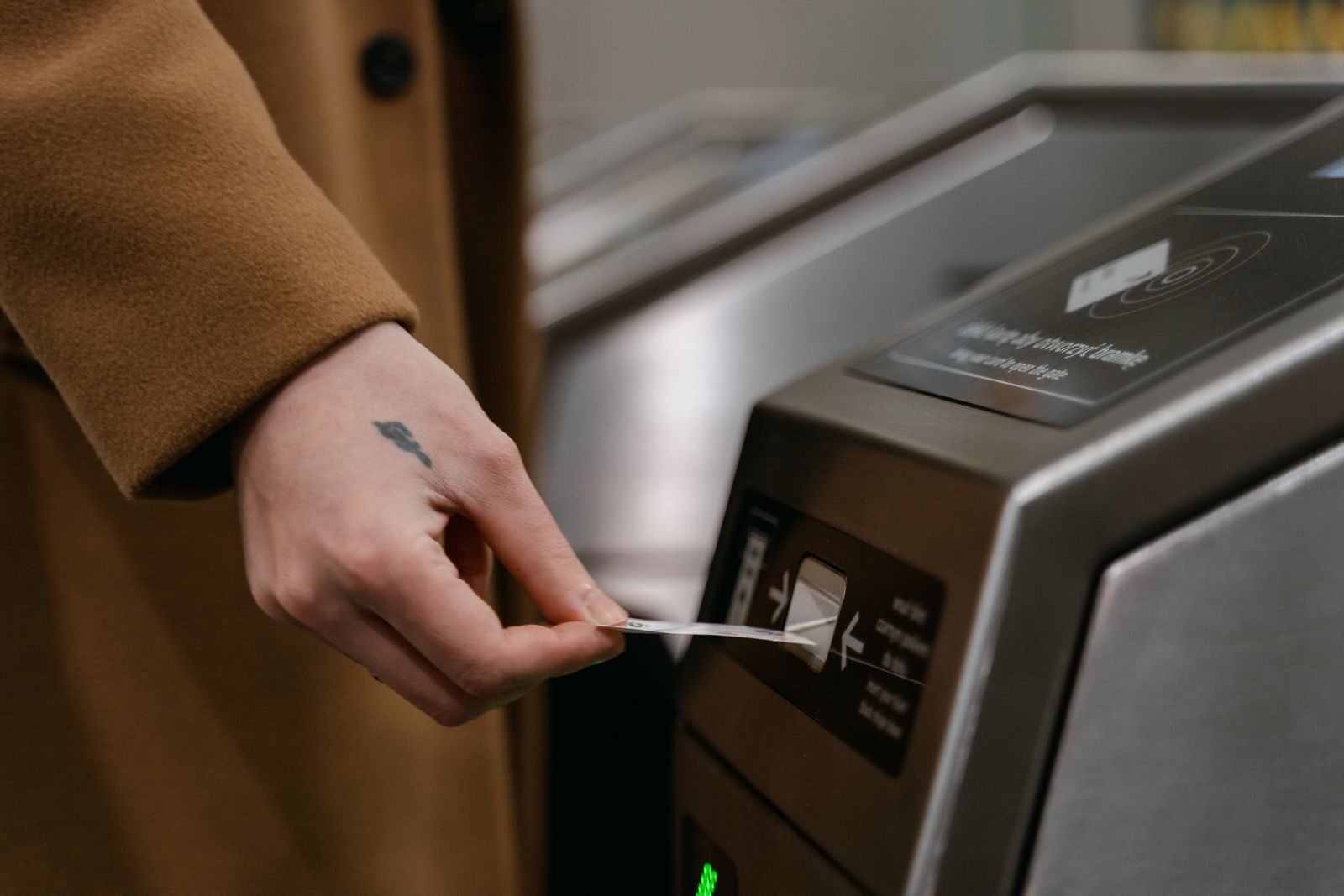
Nol is Dubai’s rechargeable smart card for public transport. It pays for the metro, the tram, RTA buses, the Dubai Ferry, the water taxi, the air conditioned abra, and even many paid car parks. You cannot pay cash on the metro, tram or buses, so sorting out a Nol card is the first practical job when you arrive.
Nol Card Types and Costs
| Card | Cost | What you get |
|---|---|---|
| Silver Nol | AED 25 (includes AED 19 credit) | Standard travel on metro, tram, bus, ferry and water taxi. Valid 5 years. The right card for almost every visitor. |
| Gold Nol | AED 25 (includes AED 19 credit) | Same as Silver, plus access to Gold Class cabins on metro and tram, at double the fare. |
| Blue Nol (Personal) | AED 70 (includes AED 20 credit) | Registered to your name with a photo. Needed for student, senior and People of Determination concession fares at half price. |
| Red Ticket | AED 2 for the paper ticket | Disposable paper ticket for up to 10 trips. Standard class only, fares about AED 1 higher per trip than Silver. Good for a single day. |
| Nol Travel | Around AED 100 (includes AED 19 credit) | A souvenir style card aimed at tourists. Same fares as Silver. Only buy it if you want the keepsake. |
For a trip of two or more days, the Silver Nol is the obvious choice. At AED 25 with AED 19 of credit included, the card itself effectively costs AED 6, and it lasts five years, so you can keep it for your next trip.
Where to Buy and Top Up a Nol Card
You can buy a Silver or Gold Nol card at any metro station ticket office or ticket machine, at RTA customer service centres, and at some bus stations. The ticket machines take cash and cards. You can also top up at the machines, at ticket offices, at many supermarkets and petrol stations, and through the RTA app. A top up takes seconds, but do it before you are standing at the gate with a train about to leave.
Two practical tips. First, keep at least AED 15 on the card, because the longest metro trip is AED 7.50 each way and you do not want to be caught short at the far end of the city. Second, remember the minimum balance rule: the gates will not let you in if your balance is below AED 7.50, the maximum single fare.
Nol Day Passes and Weekly Passes
If you plan to ride a lot in one day, a pass can save money. The regular one day pass costs around AED 20 to 22 and gives unlimited metro, tram and bus travel for one calendar day. The Gold one day pass costs around AED 40 to 42 and adds Gold Class. A 7 day all zones pass costs around AED 110, and a monthly all zones pass around AED 350. For most tourists on a 3 to 5 day trip, paying per ride on a Silver card works out about the same or cheaper, unless you are riding four or more times a day. Do the quick maths on your first evening: if you took four or more rides, buy a day pass the next morning.
Several fare guides also report a daily cap of around AED 14 on Silver and Blue cards, meaning further rides are free after you hit it. RTA’s own pages list per journey fares rather than a published cap, so treat the AED 14 figure as a useful rule of thumb rather than a promise, and check the S’hail app for the current position.
The Dubai Tram: Marina, JBR and Al Sufouh
The Dubai Tram is a short, scenic system that covers about 10.6 km along the coast from JBR and Dubai Marina out to Al Sufouh, with 11 stops. It connects with the metro at Sobha Realty station and with the Palm Monorail at Palm Jumeirah station, and it is the easiest way to move between the Marina, JBR beach and the Mall of the Emirates area without a taxi.
All 11 tram stops sit in a single fare zone, so a tram only trip is a flat AED 3 on Silver, AED 6 on Gold and AED 4 on a Red Ticket. It runs roughly 6 am to 1 am Monday to Saturday, and from 9 am on Sunday, every 9 minutes at peak and about 14 minutes off peak. The whole line takes around 40 minutes end to end, and it is a genuinely pleasant ride, especially at sunset when the light hits the Marina towers.
One warning: the tram has its own fines, and the best known one is crossing the tracks anywhere except at a marked crossing. People have been fined for jaywalking across tram tracks, so use the crossings.
RTA Buses: the Gaps the Metro Misses
RTA buses run on the same Nol card and the same zone based fares as the metro, AED 3 to 7.50 per trip. They are the only public transport to some neighbourhoods, to older residential parts of Jumeirah, to Global Village, and to the far ends of the city. They are also how you get from Terminal 2 at the airport to the metro, and from Al Maktoum International Airport (DWC) into the city.
Buses are slower than the metro and the route numbers take a little learning, which is why most tourists use them only for specific trips. The S’hail app and Google Maps both give live bus times and routes, and that is the practical way to use them: type your destination, follow the suggested bus, and tap your Nol card when you board. Feeder buses marked with an F run from metro stations into nearby neighbourhoods and are handy if your hotel sits a little way from a station.
Taxis in Dubai: Cheap, Everywhere, and Metered
Dubai taxis are cream coloured, metered, regulated by the RTA, and everywhere. You can hail one on the street, find one at a taxi rank outside every mall and hotel, or book one by app. There are also pink roof taxis for women and families, which any woman can request and which many women prefer late at night.
Dubai Taxi Fares
| Item | Fare |
|---|---|
| Street hail, daytime (6 am to 10 pm) | AED 5 flag fall |
| Street hail, night (10 pm to 6 am) | AED 5.50 flag fall |
| Per kilometre | Around AED 2.09 to 2.26 (adjusted monthly with fuel prices) |
| Minimum fare per trip | AED 12 |
| Waiting time in traffic | Around AED 0.50 per minute |
| Airport pickup flag fall | AED 20 for a standard taxi, AED 25 for a van (some sources quote AED 25 flat) |
| Salik toll gates | AED 4 off peak, AED 6 at peak times, per gate crossed |
| Trip into Sharjah | Extra AED 20 |
The per kilometre rate moves slightly from month to month with fuel prices, which is why guides quote a small range rather than one exact number. The minimum fare matters for short hops: a two minute ride still costs AED 12.
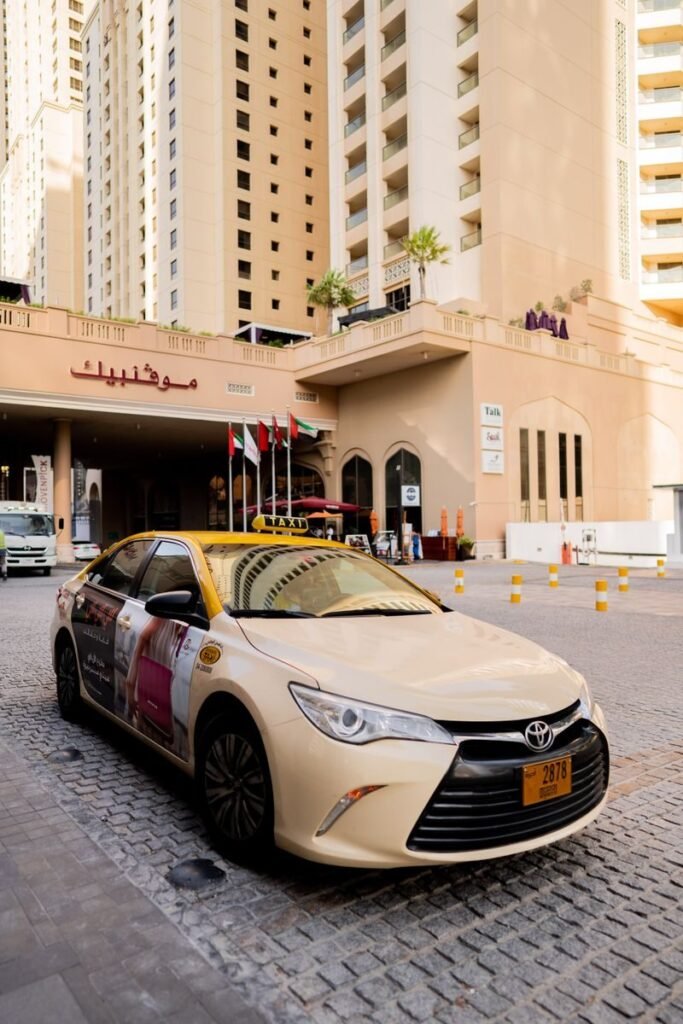
Some realistic examples, checked against 2026 fare guides. DXB airport to Downtown Dubai, about 15 km, typically costs AED 45 to 55 including the airport flag fall and one Salik gate. DXB to Dubai Marina, about 25 to 30 km, typically costs AED 60 to 70. A short ride inside Downtown, say Dubai Mall to the Address hotel area, is usually AED 12 to 15. Always check the meter is running when you get in, and if the driver suggests a fixed price instead of the meter, politely decline and take the next taxi. Metered is the law.
Airport Taxis: the One Fare That Surprises People
Taxis picked up at DXB airport ranks start at a higher flag fall than street taxis, AED 20 for a standard car and AED 25 for a family van, and some official airport pages quote AED 25 flat. That is the single most common surprise for new arrivals, and it is why the metro from Terminal 1 or Terminal 3 is such good value: the same trip to Downtown costs AED 7.50 on the metro instead of AED 45 to 55 in a taxi. If you do take a taxi from the airport, the fare is still metered after the flag fall, so there is no haggling, just a higher starting point. The same airport flag fall applies at Al Maktoum International Airport (DWC).
Taxi Tips That Save Money and Hassle
Keep small notes or a card ready, because drivers do take cards but cash is still the smoothest option. Sit in the back, buckle up, and note the taxi number on the receipt or on the door if you leave something behind: lost property in Dubai taxis is usually recoverable through the RTA. If you are going to a hotel, give the driver the hotel name and the area, not just the name, because several hotels share similar names. And if you are travelling at New Year Eve or during a major event, expect surge style pricing at event venues, with starting fares of AED 20 to 25 at the rank, and long queues. The metro is almost always the better choice on those nights.
Careem and Uber: App Rides Without Haggling
Careem and Uber both operate in Dubai, and for most visitors Careem is the more useful of the two because it includes Hala, the RTA taxi service, inside the same app. Hala is a regular metered taxi booked through the app, with no surge pricing, ever. That makes it the safest app option when demand is high.
Typical app fares in 2026 look like this. UberX and Careem Economy start at a AED 5 base fare with a per kilometre rate of around AED 2.26, a minimum fare of around AED 13 to 15, and a small booking fee of about AED 1.20. Hala through Careem starts at the AED 12 taxi base with the same per kilometre meter rate, and no surge. All app rides from DXB carry the same AED 25 airport pickup surcharge as a street taxi. Careem Economy and UberX both use dynamic surge pricing at busy times, which is why Hala is usually the better pick: the same car, the same meter, no surge.
Which should you choose? For a normal daytime trip, a street taxi and Hala cost about the same. For an airport pickup, a late night ride, or a trip during a busy event, book Hala through Careem and you will know the price is metered. For a premium car, a larger vehicle, or a scheduled pickup, Careem and Uber both offer those tiers at higher rates. Download the app and add your payment card before you land, so your first ride is ready when you are.
Boats: Abra, Water Taxi and Ferry
Dubai was a port city long before it was a skyscraper city, and the boats are still part of getting around, not just sightseeing.
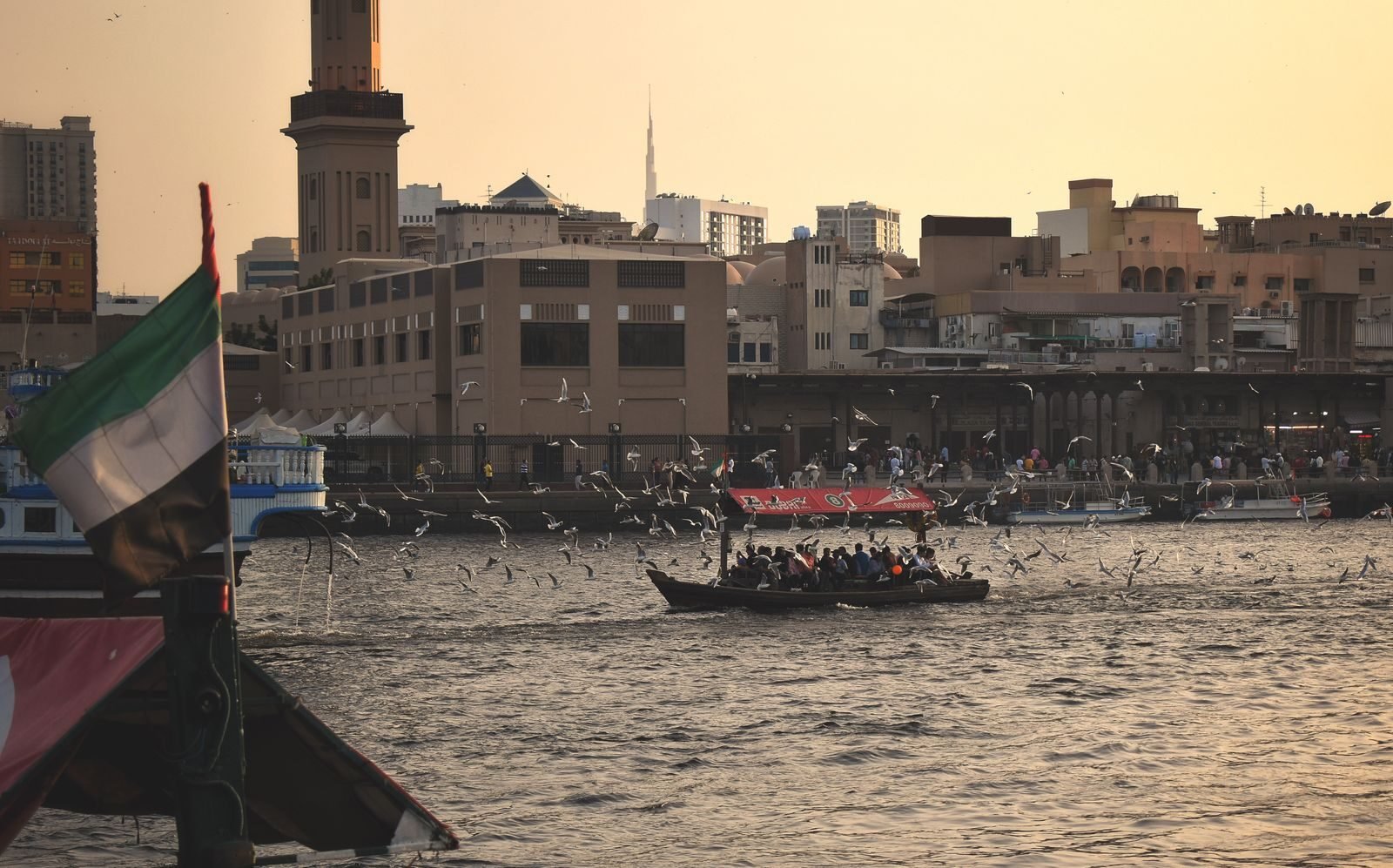
The traditional abra is the star. These small wooden boats cross Dubai Creek between Bur Dubai and Deira, from Bur Dubai station to Deira Old Souq station, in about five minutes. It costs AED 1 per person, paid in cash to the driver, and it runs from 6 in the morning to midnight. It is the cheapest ride in Dubai and one of the most memorable, especially at sunset. Carry a coin, because your Nol card does not pay for the traditional abra. Our guide to the Gold Souk Dubai explains the crossing in detail, because the abra drops you a short walk from the souk.
The air conditioned heritage abra costs AED 2 per stop and does accept Nol. The water taxi costs AED 7 per segment on the Marina and canal routes, Nol accepted. The Dubai Ferry is the bigger boat, running from Al Ghubaiba to Dubai Canal and the Marina, at around AED 25 to 35 per stop depending on the class, and it is more of a scenic trip than a commuter service. The Palm Jumeirah Monorail is separate from all of this: it runs from Palm Gateway to Atlantis, tickets cost around AED 20 return, and your Nol card does not cover it.
Walking in Dubai: Possible, but Only in the Right Places
Dubai is not a walking city in the way old European cities are, but some areas are genuinely walkable. Dubai Marina Walk, JBR The Walk, Downtown around the Dubai Mall and the Fountain, the Al Fahidi historic district and the souk lanes in Deira are all best explored on foot. Between those pockets, though, the distances are long, the roads are wide, and the summer heat is serious. From November to March, walking between nearby places is pleasant. From June to September, even a ten minute walk at midday is punishing, so take the metro or a taxi instead. Use the air conditioned walkways and metro links where they exist, particularly the link between BurJuman station and the mall, and the link from Mall of the Emirates station into the mall.
Car Rental: Only If You Really Need It
You can rent a car in Dubai, and the roads are excellent, but for most tourists it is not worth it. Parking in Downtown and the Marina is expensive and hard to find, Salik toll gates add up, and you will spend your holiday navigating interchanges instead of enjoying the city. Car rental makes sense only if you are planning day trips outside Dubai, to Abu Dhabi, Hatta or the desert, or if you are staying in a villa community far from the metro. If you do rent, you need your home driving licence plus an International Driving Permit for most nationalities, or a UAE licence if you are a resident. Daily rental for a basic sedan typically starts around AED 100 to 150, plus fuel and Salik, but check live prices because they move with the season. For a normal Dubai city trip, skip the car and spend the money on experiences instead.
Getting From the Airport: DXB and DWC
Most visitors arrive at Dubai International Airport (DXB), and the best transfer depends on your arrival time and your hotel.
From Terminal 1 or Terminal 3, the metro is the cheapest option. The station is inside the terminal, a Silver Nol card costs AED 25 at the ticket machine, and the ride to Downtown is AED 7.50 and takes about 25 minutes. If you arrive after midnight on a night other than Friday, the metro is closed, so take a taxi or book a Careem. From Terminal 2, which has no metro station, take a taxi or the bus to the nearest metro station.
Al Maktoum International Airport (DWC) in Dubai South is much further out, about 45 minutes from the Marina by road. There is no metro there yet, so your options are a taxi, a Careem booking, or an RTA bus into the city. Budget roughly AED 80 to 120 for a taxi from DWC to the Marina, and more to Downtown, and check the meter and the Salik gates on the route.
How Much Does Getting Around Dubai Cost Per Day?
For a typical sightseeing day using the metro for longer trips and walking for the rest, budget AED 15 to 30 per person per day on public transport. If you take two or three taxis as well, budget AED 50 to 100 per day. A heavy taxi day, airport transfer plus several cross city rides, can reach AED 150 to 200. The table below shows three realistic days.
| Day style | Transport used | Rough cost per person |
|---|---|---|
| Budget, metro and walking | 3 to 4 metro rides, 1 abra | AED 15 to 30 |
| Mixed, metro plus taxis | 2 metro rides, 2 short taxi rides | AED 50 to 80 |
| Comfortable, taxis and Careem | Airport transfer plus 3 to 4 app rides | AED 120 to 200 |
Common Mistakes When Getting Around Dubai
The mistakes are almost always the same, and they are all avoidable. Trying to pay cash on the metro, which does not accept it. Forgetting to tap out, which charges the maximum fare. Taking a taxi from the airport rank without knowing the AED 20 to 25 flag fall. Standing on the wrong side of the platform, or getting on a train going the wrong way, which is easy at Union and BurJuman where the lines cross. Planning a Sunday morning around a 5 am start, when the metro does not open until 8 am. And walking long distances in summer heat, which turns a pleasant day into an exhausting one. Avoid those six, and getting around Dubai is straightforward.
The Bottom Line on How to Get Around Dubai
Dubai rewards visitors who use the metro and the Nol card. Buy a Silver Nol card at the airport, learn the two metro lines, and keep a taxi app on your phone for the gaps. That combination covers the whole city for a few dirhams a day, and it leaves your money for the things that actually make the trip, the views, the food and the desert. Check the RTA S’hail app before any late night journey, and check rta.ae for the latest fares, because this is one part of Dubai that does change, and the official source is always the one to trust. The Roads and Transport Authority publishes current fares, timings and service updates on its official site, and Visit Dubai has practical transport guides for first time visitors.
How do I get around Dubai as a tourist?
Use the metro for most trips, with a Silver Nol card that costs AED 25 including AED 19 of credit. Add taxis or Careem for short trips and places the metro does not reach, and use the AED 1 abra to cross the Creek in Old Dubai.
How much does the Dubai Metro cost?
A single ride costs AED 3 for one zone, AED 5 for two zones and AED 7.50 for three or more zones on a Silver Nol card. Gold Class costs double, and a paper Red Ticket costs about AED 1 more per trip.
What is a Nol card and do I need one?
A Nol card is Dubai’s rechargeable travel card for the metro, tram, buses, ferry and water taxi. You need one, because cash is not accepted on the metro, tram or buses. A Silver Nol costs AED 25 including AED 19 of credit and is valid for five years.
Which Nol card is best for tourists?
The Silver Nol card. It costs AED 25 with AED 19 of credit, covers all standard travel, and works for five years. Buy the Gold Nol only if you want to ride in Gold Class cabins.
Where can I buy a Nol card in Dubai?
At any metro station ticket office or ticket machine, at RTA customer service centres, and at some bus stations. Ticket machines take cash and cards, and you can top up at the same machines, at supermarkets and petrol stations, or through the RTA app.
What time does the Dubai Metro open and close?
The metro runs 5 am to midnight Monday to Thursday and Saturday, 5 am to 1 am on Friday, and 8 am to midnight on Sunday. The last useful train from your station can leave a little before closing time, so do not cut it too fine.
How much is a taxi from Dubai Airport to Downtown?
A standard taxi from DXB to Downtown Dubai typically costs AED 45 to 55, including the AED 20 to 25 airport flag fall, the per kilometre rate and one Salik toll gate. The metro does the same trip for AED 7.50.
Is Careem or Uber cheaper than a taxi in Dubai?
For a normal daytime trip they cost about the same. Hala, the RTA taxi service inside the Careem app, is often the best choice because it is metered with no surge pricing, while Careem Economy and UberX can surge at busy times.
How much is the abra in Dubai?
The traditional wooden abra across Dubai Creek costs AED 1 per person, paid in cash to the driver. It runs from 6 am to midnight and takes about five minutes. The air conditioned abra costs AED 2 per stop and accepts Nol.
Can I walk around Dubai?
In some areas, yes. Dubai Marina Walk, JBR The Walk, Downtown and the old souk districts are pleasant on foot from November to March. In summer, and between districts, take the metro or a taxi instead, because distances are long and the heat is serious.
Does the Dubai Metro go to the airport?
Yes. The Red Line serves Terminal 1 and Terminal 3 at DXB, with stations inside the terminals. Terminal 2 has no metro station, so take a taxi or bus from there. Al Maktoum International Airport (DWC) has no metro yet.
Is it worth renting a car in Dubai?
For most visitors, no. The metro and taxis cover the city well, parking in Downtown and the Marina is expensive, and Salik tolls add up. Rent a car only for day trips outside Dubai, such as Abu Dhabi or Hatta.
Do I need cash for transport in Dubai?
A little. The metro, tram, buses and water taxi need a Nol card, and taxis and app rides take cards. But the traditional AED 1 abra is cash only, so keep a few coins and small notes with you.
What is the cheapest way to get around Dubai?
The metro on a Silver Nol card, at AED 3 to 7.50 per ride, plus the AED 1 abra in Old Dubai. A full day of sightseeing by metro and on foot usually costs AED 15 to 30 per person.
#DubaiTravel #DubaiMetro #NolCard #VisitDubai #DubaiTransport #DubaiTips
This collection is curated by the UAE Look Team, a group of writers covering fashion, travel, food and living in the UAE and across the Middle East. Our team checks every price, place and detail before publishing, so you get honest, practical guides for Dubai and beyond.
One Response